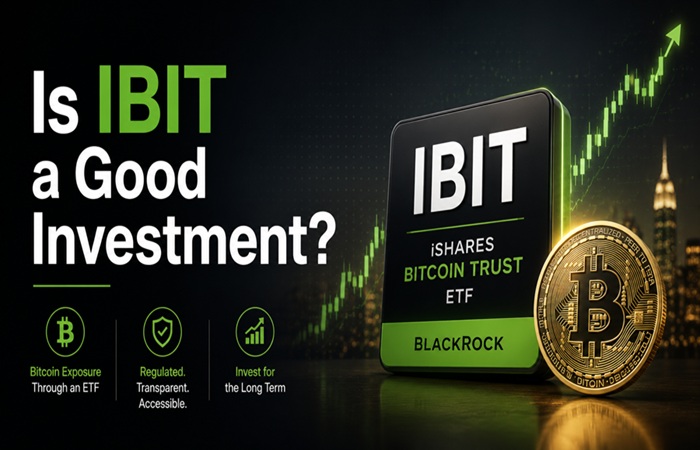
When the U.S. Securities and Exchange Commission approved spot Bitcoin ETFs in January 2024, it was a moment the crypto industry had been waiting years for. Among the products that launched that day, one quickly separated itself from the rest. BlackRock’s iShares Bitcoin Trust, trading under the ticker IBIT, grew faster than almost any ETF in history, pulling in tens of billions in assets within its first year. For millions of traditional investors who had been curious about Bitcoin but wary of crypto exchanges and digital wallets, IBIT suddenly made that exposure accessible through a familiar brokerage account.
But accessible does not automatically mean suitable. Whether IBIT is a good investment depends entirely on who you are, what you are trying to accomplish, and how clearly you understand what you are actually buying. Here is a thorough breakdown of everything investors need to know.
What Exactly Is IBIT?
IBIT is a spot Bitcoin ETF, which means it holds actual Bitcoin rather than futures contracts or derivatives. Every share you purchase represents fractional ownership of real Bitcoin stored in institutional cold storage. The fund is managed by BlackRock, the world’s largest asset manager with over $10 trillion in assets under management, and the Bitcoin itself is custodied by Coinbase Custody, the institutional arm of Coinbase.
The fund trades on the Nasdaq just like any ordinary stock, from 9:30 AM to 4:00 PM Eastern Time on weekdays. It carries a 0.25 percent annual expense ratio, meaning you pay $2.50 per year for every $1,000 invested. It pays no dividends, since Bitcoin generates no income. All returns come exclusively from price appreciation of the underlying asset.
For anyone who has an existing brokerage account and wants Bitcoin exposure without the technical complexity of managing crypto wallets and private keys, IBIT removes nearly all of that friction.
The Case for IBIT as an Investment
The arguments in favor of IBIT are meaningful, and they go beyond mere convenience.
First, the institutional credibility behind the product is substantial. BlackRock does not attach its name to investments lightly. The firm spent years working with regulators before receiving approval, and its involvement has helped legitimize Bitcoin as an asset class in the eyes of pension funds, wealth managers, and financial advisors who previously had no compliant pathway to offer clients Bitcoin exposure.
Second, IBIT is by far the most liquid Bitcoin ETF in the U.S. market. Higher liquidity generally translates to tighter bid-ask spreads and better price execution for investors, which matters more than most people realize when entering and exiting positions.
Third, the macro case for Bitcoin as a long-term store of value has grown stronger. Corporate treasuries and sovereign funds are increasingly treating it as a reserve asset. Bitcoin’s post-halving supply dynamics mean annual new supply is now below one percent of total supply, creating structural scarcity. For investors who want exposure to that thesis without the complexity of self-custody, IBIT is the cleanest available vehicle.
By early 2026, total assets across U.S. spot Bitcoin ETFs exceeded $100 billion, with IBIT accounting for the dominant share. In April 2026 alone, the broader Bitcoin ETF complex absorbed $2.44 billion in net inflows as Bitcoin rallied back toward the $80,000 range. These are not speculative boutique flows. They reflect serious, sustained institutional demand.
The Real Risks You Need to Understand
No honest assessment of IBIT can skip the risks, and they are significant.
Bitcoin is extraordinarily volatile. It is not uncommon for the asset to fall 30, 40, or even 50 percent from its highs within a single cycle before eventually recovering. IBIT experienced a total return of roughly negative 30 percent over one recent twelve-month window, a drawdown that would test the resolve of most investors. Anyone who cannot stomach watching their investment lose a third of its value in a year without panic-selling has no business putting meaningful capital into IBIT.
There is also a custodian concentration risk that rarely gets discussed in marketing materials. Approximately 85 percent of Bitcoin held across all U.S. spot Bitcoin ETFs is custodied by a single firm, Coinbase Custody. If Coinbase were to face a major operational or regulatory disruption, the cascading effect across the entire U.S. Bitcoin ETF market would be severe. This is not a likely scenario, but it is a systemic risk worth understanding before committing capital.
Additionally, IBIT trades only during regular market hours. Bitcoin itself never sleeps. When significant news breaks on a weekend evening and Bitcoin moves sharply overnight, IBIT holders cannot respond until Monday morning. For investors who want to be nimble in reaction to crypto-specific news, this is a genuine limitation.
IBIT vs. Buying Bitcoin Directly
The question of whether to buy IBIT or hold Bitcoin directly is one that deserves careful thought rather than a reflexive answer either way.
As Motley Fool’s comparison of Bitcoin ETF options explains, the main factors separating IBIT from direct Bitcoin ownership come down to fees, custody, convenience, and tax treatment. IBIT’s 0.25 percent annual fee creates a slow but compounding drag against Bitcoin’s actual price over very long holding periods. If you hold IBIT for fifteen or twenty years, that fee adds up. Direct Bitcoin ownership has no ongoing fee, though it does require the discipline and technical knowledge to manage secure self-custody.
On taxes, IBIT is actually simpler. Buying and selling Bitcoin directly can trigger taxable events in ways that catch many investors off guard, especially if they use it for transactions. IBIT shares generate straightforward 1099-B reporting through your brokerage, much like any stock sale.
For most mainstream investors, the convenience and regulatory clarity of IBIT outweigh the fee drag, particularly for holding periods of five to ten years or less. For long-term conviction holders who are comfortable with self-custody, owning Bitcoin directly may ultimately deliver better results.
Who Should Actually Consider IBIT?
IBIT makes the most sense for a specific type of investor. If you already have a brokerage or retirement account and want a small allocation to Bitcoin as part of a diversified portfolio, somewhere in the range of one to five percent, IBIT is an exceptionally clean way to get that exposure. The institutional backing, regulated structure, and familiar trading mechanics remove most of the operational friction that has historically kept traditional investors away from crypto.
It is a poor fit for investors who need stability, cannot tolerate sharp drawdowns, or are investing money they may need within a year or two. Bitcoin is a long-duration asset. The thesis behind it plays out over years and market cycles, not months. Investing in IBIT with a short time horizon and low risk tolerance is a setup for exactly the kind of panic-selling that destroys returns.
The Bottom Line
IBIT is not a good or bad investment in isolation. It is a well-constructed, highly liquid, institutionally backed vehicle for gaining exposure to one of the most volatile and asymmetric assets in modern financial markets. Whether that exposure is appropriate for your portfolio depends entirely on your time horizon, your risk tolerance, and your conviction in Bitcoin’s long-term value.
Approach it with clear eyes about the volatility involved, keep the allocation sized to what you could genuinely afford to lose without disrupting your financial life, and hold it with patience if you hold it at all. On those terms, IBIT is arguably the best available tool for accessing the Bitcoin thesis from within the traditional financial system.
This article is for informational purposes only and does not constitute financial advice. Please consult a qualified financial advisor before making any investment decisions.