There is a peculiar kind of selective hearing that surrounds entrepreneurship. The stories that circulate most widely are about the exits, the raises, the hockey-stick growth curves, and the founders who bet everything and won. The assumptions those founders made in the process, the full weight of risk and responsibility they voluntarily took on, rarely get the same airtime. The result is that many people enter business ownership underprepared not for lack of intelligence or effort but because nobody fully explained what they were signing up for.
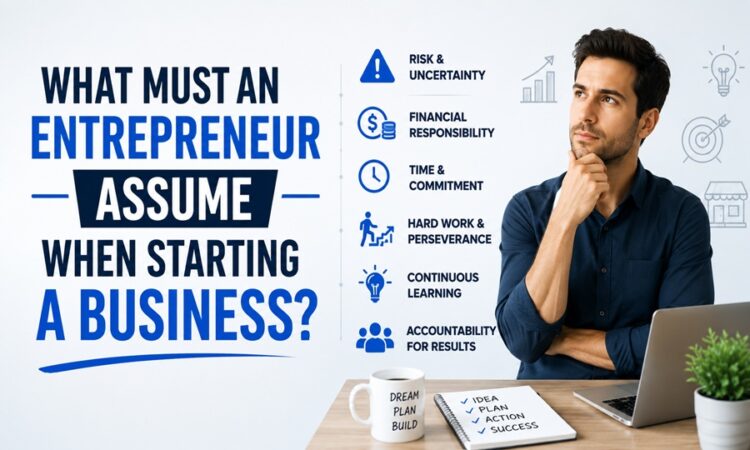
What must an entrepreneur assume when starting a business? The answer is not a motivational checklist. It is a set of foundational realities about risk, responsibility, time, money, and personal resilience that every serious founder needs to internalize before they are tested by them. Here is an honest account of each.
Assume That Risk Is Not Optional and Not Temporary
The most foundational thing an entrepreneur must assume when starting a business is that risk is not a feature of the early days that goes away once the company is established. It is a permanent condition of ownership, and accepting it consciously rather than discovering it reluctantly is one of the most important mindset distinctions between entrepreneurs who thrive and those who are perpetually surprised by how hard it is.
Risk in entrepreneurship takes several distinct forms. Market risk is the possibility that the problem you are solving does not matter enough to enough people, that the market is smaller than you estimated, or that it moves in an unexpected direction. Financial risk is the possibility that the business runs out of money before it reaches profitability, or that personal assets tied to the business are exposed if the venture fails. Reputational risk is the possibility that a mistake, a bad customer experience, or a public misstep affects the brand in ways that are difficult to recover from. Operational risk covers the daily reality that equipment fails, suppliers disappoint, key employees leave, and processes that worked at small scale break at larger scale.
Entrepreneurs who enter business ownership assuming these risks are manageable but real are far better prepared than those who assume their concept or their effort is sufficient insulation against them. Every successful entrepreneur has a story of a risk that materialized. What distinguished their outcome was not the absence of adversity but the preparation and resilience they brought to it.
Assume Full Personal Responsibility for Every Outcome
An entrepreneur who starts a business assumes responsibility in a way that employment does not require. When something goes wrong in a business, there is no manager above you to escalate to, no HR department to help resolve it, no organizational system that absorbs the impact before it reaches you. The buck stops at the founder, comprehensively and without exception.
This encompasses responsibility for financial outcomes, including the livelihoods of any employees whose jobs depend on the business generating enough revenue. It encompasses responsibility for the customer experience, because the owner’s name and reputation are directly connected to every interaction the business has. It encompasses regulatory compliance, because ignorance of the law is not a defense available to a business owner facing a penalty. And it encompasses strategic decisions, because the choices made by the founder about markets, products, pricing, and partners determine the trajectory of the entire enterprise.
This level of accountability is simultaneously the most demanding and the most meaningful aspect of entrepreneurship. The freedom that comes with building something of your own is inseparable from the weight of owning every dimension of it.
Assume That It Will Take Longer Than You Expect
One of the most consistent findings in research on entrepreneurship is that founders systematically underestimate how long it takes to reach the milestones they are working toward. The first customer takes longer than the business plan projected. The product takes longer to build or refine than the original timeline suggested. Profitability arrives later than the financial model indicated. Investment takes more rounds of relationship building than anyone described in advance.
Shopify’s research on entrepreneurial experience found that even for successful businesses, the journey from founding to genuine traction is often a ten to fifteen-year arc. The overnight successes that get covered in media are the result of years of unglamorous work that happened out of view. Assuming a realistic timeline, one measured in years rather than months for most meaningful businesses, is one of the most important things an entrepreneur can do to maintain the patience that sustained execution requires.
This assumption has practical financial implications as well. A business plan that assumes profitability within six months requires a very different personal financial cushion than one that honestly plans for a two-year runway. Entrepreneurs who underestimate the timeline frequently run out of money or energy before the business has had enough time to find its footing.
Assume That Financial Uncertainty Will Test You Personally
The financial dimension of entrepreneurship is the one that surprises most founders most profoundly. Starting a business typically means sacrificing stable income for a period of uncertain, often delayed, and sometimes nonexistent compensation. Even businesses that are ultimately successful frequently pass through extended periods where the owner pays themselves little or nothing in order to sustain operations.
An entrepreneur must assume that they will need a personal financial cushion adequate to fund their own life through the lean period without the business providing income. How large that cushion needs to be depends on personal expenses, the nature of the business, and the realism of the financial projections, but the assumption that it is needed is universal.
As the U.S. Small Business Administration’s financial readiness guidance for entrepreneurs explains, understanding your personal financial situation, including how long your savings can sustain you without business income, is a critical step in evaluating whether you are genuinely ready to start a business. Many business failures that appear to be market failures are actually founder failures, in the sense that the founder ran out of personal financial runway before the business had time to reach sustainability.
Assume That Your Initial Assumptions About the Market Will Be Wrong
A counterintuitive but essential assumption for any entrepreneur starting a business is that many of the beliefs they hold about their customers, their product-market fit, their pricing sensitivity, and their competitive environment will turn out to be incorrect or incomplete when tested against reality.
This is not a counsel of pessimism. It is a counsel of scientific humility that the most effective founders consistently apply. The business plan built before the first customer is a hypothesis. Every interaction with real customers, every piece of sales data, every support request, and every churn event is data that either confirms or challenges that hypothesis. Entrepreneurs who treat their initial assumptions as facts rather than starting points resist the customer feedback that would allow them to improve, and they invest in building things the market has not actually validated.
Assuming in advance that iteration will be necessary, that the first version will not be the best version, and that the business model that makes most sense in year three may look quite different from the one drawn up before launch is what allows founders to build genuine learning and adaptation into their operating approach rather than experiencing those corrections as failures.
Assume That the Work Is Harder Than It Looks From the Outside
Almost every entrepreneur who reflects honestly on their experience says that the reality of starting a business was significantly harder than they anticipated. This is not because they lacked information. It is because some dimensions of difficulty cannot be fully understood until you are inside them.
Managing the emotional volatility of a venture where highs and lows alternate unpredictably, often within the same week, is psychologically demanding in ways that employment rarely requires. Making decisions under persistent uncertainty, without the data you would ideally want, is cognitively taxing over extended periods. Managing relationships with employees who depend on you, customers who have expectations of you, and investors or partners who have their own priorities is interpersonally complex in ways that require skills many first-time founders are still developing.
Assuming that the work will be hard does not mean assuming that it will be miserable. Many entrepreneurs describe their experience, in retrospect, as the most meaningful work they have ever done. But the meaning comes through the difficulty, not despite it. An entrepreneur who assumes comfort will be disappointed. An entrepreneur who assumes challenge and prepares accordingly will find the experience of building something genuinely worth building.
Assume That Learning Never Stops
The final assumption every entrepreneur must carry into a new business is that they do not yet know most of what the business will eventually require them to know. Starting a business is a commitment to perpetual learning in domains that range from product development and sales to financial management, legal compliance, leadership, and strategic planning.
The founders who build the most enduring businesses are almost always voracious learners who treat each operational challenge as an opportunity to build a capability rather than a problem to assign to someone else. They read, seek mentors, find networks of other founders who have navigated similar challenges, and approach their own ignorance with curiosity rather than defensiveness.
Assuming that learning is a permanent requirement of entrepreneurship rather than a temporary phase before you know enough is one of the most practically important orientations a founder can bring to starting a business. The market changes, technology changes, competition changes, and the business itself changes as it grows. The entrepreneur who is still learning stays aligned with that movement. The one who stopped learning falls behind it.
Starting a business is one of the most demanding and most rewarding commitments a person can make. The entrepreneurs who navigate it most successfully are not the ones who assumed it would be easy. They are the ones who assumed it would be hard, accepted that assumption fully, and decided it was worth it anyway.
This article is for informational and educational purposes only. Please consult qualified professionals for guidance specific to your business situation.