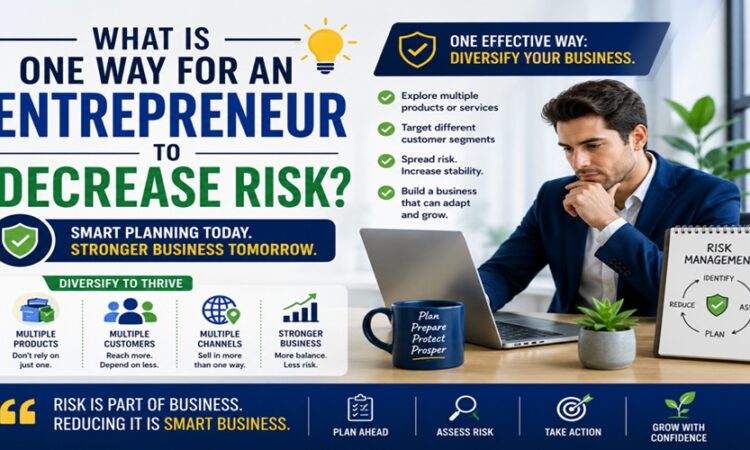
Validate before you build.
That’s the short answer. If there’s a single habit that separates entrepreneurs who lose their savings on a failed idea from those who build something sustainable, it’s the discipline to test demand before committing significant time, money, or resources to a business concept.
But the longer answer is worth understanding — because validation is a principle, not a single action, and it applies at every stage of building a business, not just the beginning.
Why Most Entrepreneurial Risk Is Self-Inflicted
A common assumption about business failure is that it’s mostly bad luck — wrong timing, wrong market, wrong economic conditions. The data tells a different story. Research consistently shows that the leading cause of startup failure is building something nobody wants. Not poor execution, not underfunding, not competition. A product or service that didn’t have sufficient real demand to sustain a business.
That kind of failure is largely preventable. It doesn’t require a large budget to avoid — it requires a willingness to ask uncomfortable questions early, before the costs of being wrong are high.
Validation: Testing Before Committing
Validation means finding evidence that real people will pay real money for what you’re planning to sell — before you’ve invested heavily in building it.
This can take many forms depending on the business. A service business can validate by landing one paying client before building a full marketing infrastructure. A product business can validate with a pre-sale or crowdfunding campaign before manufacturing inventory. A content business can validate by building an audience around a topic before monetizing it.
The specific method matters less than the underlying principle: replace assumptions with evidence as early as possible, and let that evidence guide decisions rather than intuition alone.
Entrepreneurs who skip this step tend to fall into what’s sometimes called “build trap” thinking — investing months of effort into a polished product based on the belief that customers will appear once it’s ready. Sometimes they do. Often they don’t, and by then the sunk cost of time and money makes it psychologically harder to pivot or stop.
Other High-Impact Ways to Reduce Risk
Validation is foundational, but risk management in entrepreneurship is multi-layered. Several other approaches compound the benefit.
Start lean, stay lean. Keeping overhead low in the early stages of a business extends runway — the amount of time you have to find a viable model before running out of money or energy. Every unnecessary expense before product-market fit is a bet against yourself. Lean operations also force prioritization: when resources are limited, you focus on what actually drives revenue.
Don’t quit your day job yet. One of the most practical risk-reduction strategies available to early-stage entrepreneurs is maintaining income while building. Testing a business model on evenings and weekends before making it your primary livelihood dramatically reduces the financial pressure that leads to poor decisions. Many successful businesses were validated part-time before their founders made the full transition.
Know your numbers. A surprising number of entrepreneurs run businesses without a clear understanding of their unit economics — what it costs to acquire a customer, what margin each sale generates, and at what revenue level the business covers its costs. These aren’t complex calculations, but businesses that don’t track them tend to scale problems as readily as they scale revenue. Understanding your numbers early gives you the information needed to make decisions rather than guesses.
Diversify your customer base early. A business with one or two large clients isn’t a business — it’s a dependency. If either client leaves, revenue can collapse overnight. Building a broader customer base, even at the cost of some early convenience, creates resilience that single-client concentration doesn’t.
Build in stages. Breaking a large business initiative into smaller, sequenced steps allows you to test assumptions at each stage before committing to the next. Instead of launching a full product line, launch one product. Instead of opening three locations, open one. Each stage generates real-world information that either confirms or adjusts the plan — at a fraction of the cost of committing to the full vision upfront.
The Risk You Can’t Eliminate
It’s worth being honest about something: entrepreneurship carries irreducible risk. Markets shift. Competitors emerge. Technology changes. Personal circumstances intervene. No amount of planning or validation eliminates the possibility of failure entirely.
What validation and disciplined risk management do is change the odds — and change the nature of the risk. A business that has validated demand, kept costs lean, and built a diversified customer base might still fail, but it’s unlikely to fail for the most common and preventable reasons. The risks that remain are the genuinely unpredictable ones, and those are the ones worth accepting.
What Research and Institutions Say
The connection between early validation and entrepreneurial success is well-documented. The lean startup methodology — popularized by Eric Ries and now taught in business schools worldwide — is built almost entirely around this principle: treat every business assumption as a hypothesis and test it with the minimum viable effort before scaling.
The SCORE Association, a nonprofit backed by the U.S. Small Business Administration and one of the country’s largest networks of volunteer business mentors, consistently identifies market validation and financial literacy as the two most impactful risk-reduction habits for early-stage entrepreneurs.
The Practical Starting Point
If you’re an entrepreneur trying to reduce risk right now, the most useful question to ask is: what is the cheapest, fastest way I can find out whether people will pay for this?
Not whether they think it’s a good idea. Not whether they say they’d buy it. Whether they actually hand over money — or take a concrete action that indicates genuine intent.
The answer to that question is your validation strategy. Everything else follows from it.